Posted in BRIDGES IPO news, News on Mar 25, 2026.
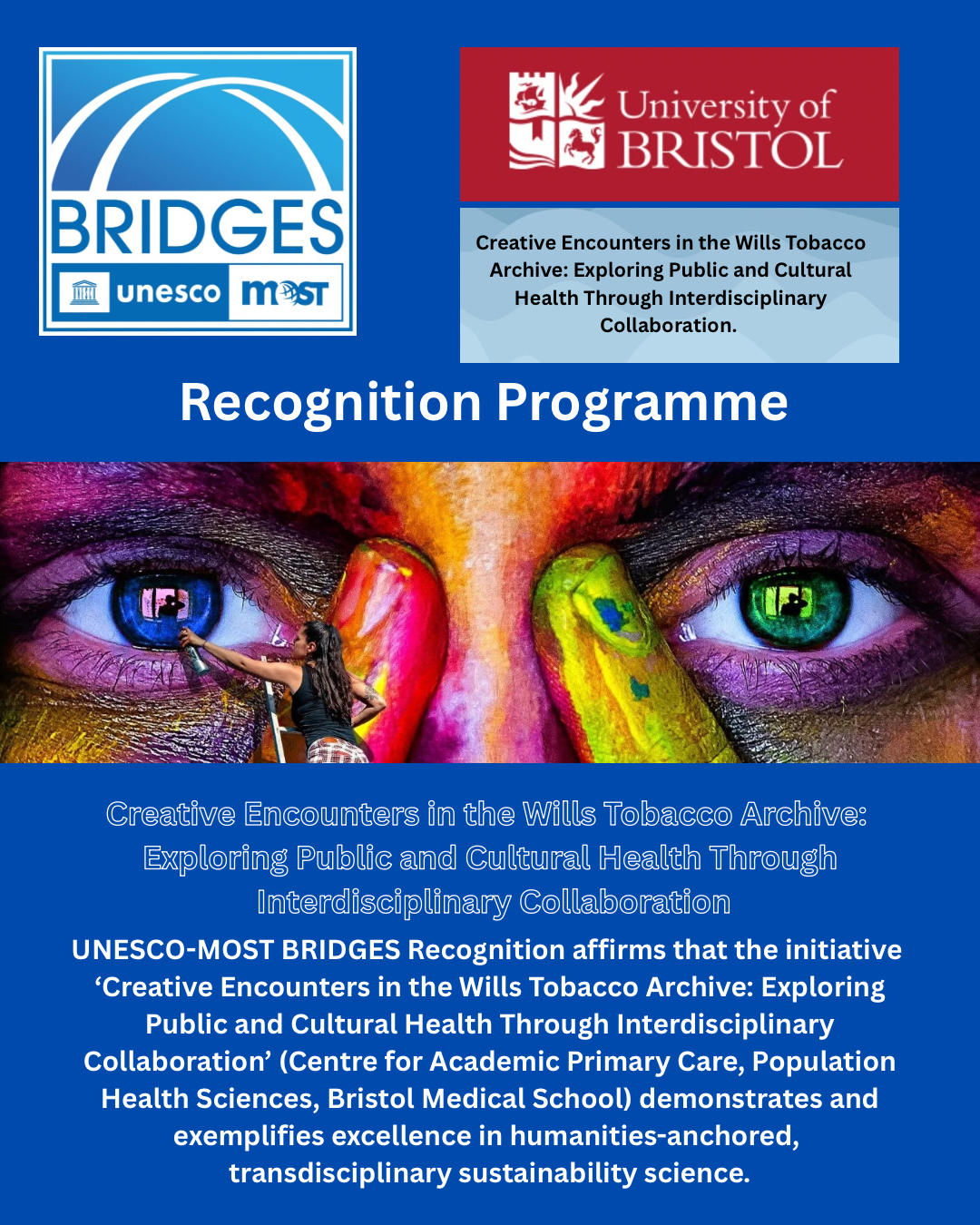
The UNESCO-MOST BRIDGES Coalition is proud to announce the formal recognition of the initiative ‘Creative Encounters in the Wills Tobacco Archive: Exploring Public and Cultural Health Through Interdisciplinary Collaboration’ as an outstanding example of humanities-anchored, transdisciplinary sustainability science.
This recognition follows a rigorous evaluation of the project’s alignment with BRIDGES’ principles, emphasising its ethical, transformative, and socially responsible practices.
This project, supported by an AHRC Curiosity Award, investigates how creative engagement with colonial archives can address persistent socio-ecological challenges. By using the Wills Collection of Tobacco Antiquities at the M-Shed Museum, the initiative examines the deep-rooted links between Bristol’s tobacco industry (1786–1988) and contemporary health inequalities. The project specifically focuses on communities like Hartcliffe, where smoking rates are significantly higher than the national average, to explore how humanities-led approaches can bridge colonial heritage trauma and modern public health challenges.
Societal Challenges
The project addresses the stark reality of health inequality: Bristol’s smoking rates reach 31.2% in Hartcliffe, compared to an English average of 13%. This local disparity mirrors global patterns where Indigenous peoples experience disproportionately higher tobacco use, reflecting structural connections between colonial tobacco commercialisation and persistent health inequities.
Furthermore, the project tackles heritage challenges within archives like the Wills Collection, which often separate plants from their original Indigenous contexts to create commercial narratives. It also intersects with climate justice through Hartcliffe’s environmental leadership via Heart of BS13, transforming industrial legacy into community healing.
Humanities-Informed Approach
The research centres Indigenous knowledge systems and creative practice as foundational tools. Key elements include:
Transdisciplinary Collaboration
The "creative encounters" methodology generates knowledge through the convergence of diverse disciplines:
Collaborative Partnerships
Methodological Importance
The project's importance lies in its ability to decolonise archives through community guidance, preventing retraumatisation. By using different disciplinary backgrounds, the research generates a richer understanding of archival materials. This community-centred practice transforms systemic challenges into local strengths, creating accessible resources and new knowledge simultaneously.
Sustainable Development Goals
Through the project's focus on public health, colonial heritage, community-led climate action, and transdisciplinary partnerships, the Creative Encounters in the Wills Tobacco Archive initiative addresses several of the United Nations SDG’s: SDG 3: Good Health and Well-being; SDG 10: Reduced Inequalities; SDG 11: Sustainable Cities and Communities; SDG 13: Climate Action; and SDG 17: Partnerships for the Goals.
Expected Outcomes and Legacy
Immediate (Year 1) • Documented protocols for ethical archival engagement; enhanced community capacity in Hartcliffe; development of audio drama scenes.
Medium-term (1–2 Years)
• Full audio drama production; M-Shed adoption of community-centred representation; policy integration into the Bristol Integrated Care Strategy.
Long-term (2–5 Years)
• Enhanced understanding of colonial legacy in health patterns; a global model for ethical archive engagement; sustained community empowerment in heritage interpretation.
The work of Creative Encounters in the Wills Tobacco Archive: Exploring Public and Cultural Health Through Interdisciplinary Collaboration strengthens the global UNESCO-MOST BRIDGES network and contributes meaningfully to transformative, humanities-anchored community-led initiatives.
We heartily congratulate Creative Encounters in the Wills Tobacco Archive: Exploring Public and Cultural Health Through Interdisciplinary Collaboration on the official endorsement of BRIDGES recognition and commend their contribution to highlighting how the humanities can drive sustainability science to address modern environmental crises.
Learn More: Affiliated Websites
BRIDGES Recognition: Are you working on a project that’s making a difference to local communities and our shared planet? Learn more about the BRIDGES recognition programme.