Posted in News, UWTSD Hub News on Mar 30, 2026.
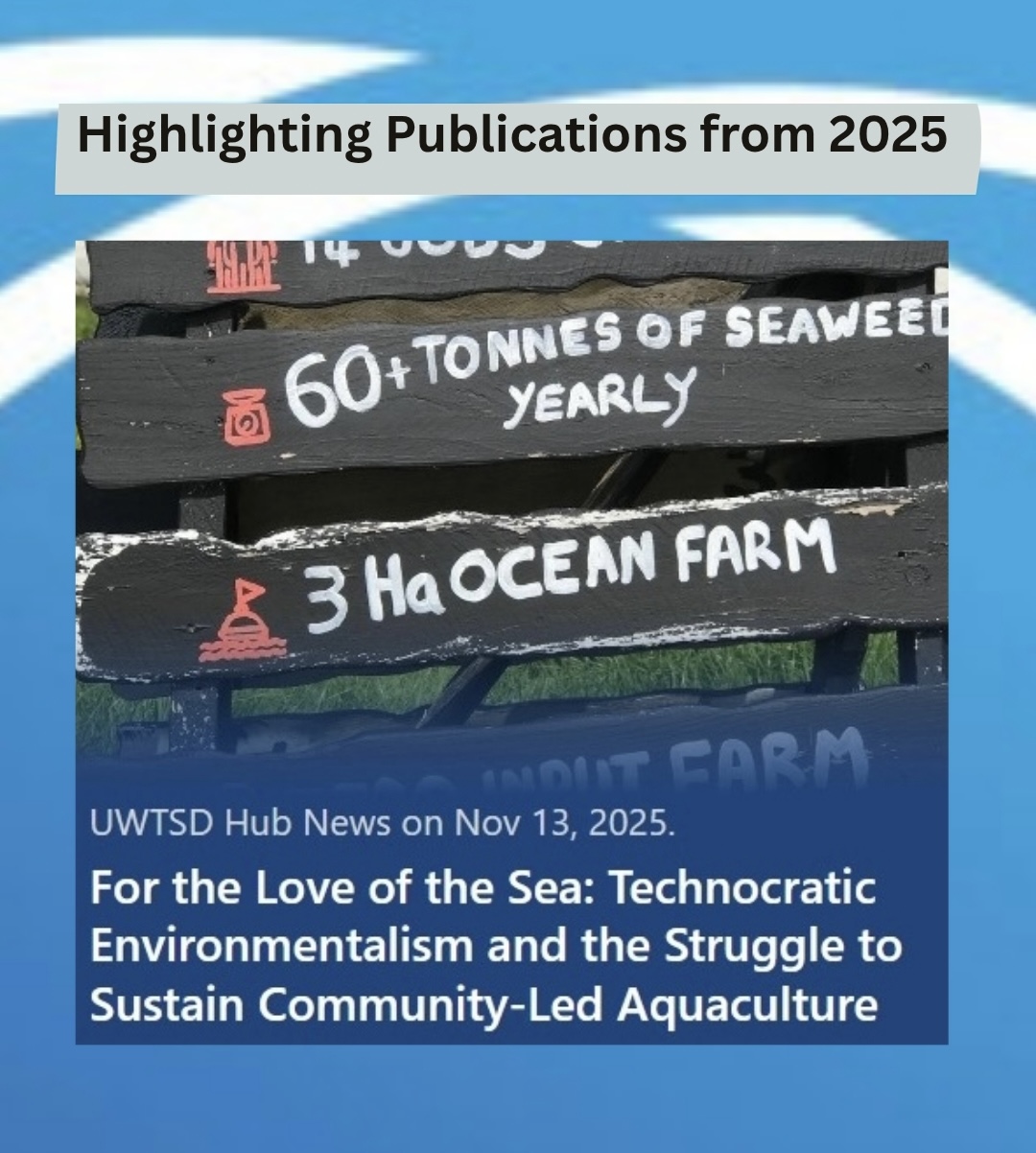
Highlighting Publications: For the Love of the Sea: Technocratic Environmentalism and the Struggle to Sustain Community-Led Aquaculture
Authors: Gareth Thomas, Louise Steel, and Luci Attala
Published in: Sustainability 2025, 17(22), 10136. 13 November 2025
Continuing our series highlighting publications from last year, this paper explores the internal dynamics of Câr-y-Môr, Wales’s first community-owned regenerative ocean farm. The authors argue that sustainability governance in small-scale aquaculture is primarily driven by the relational, ethical, and temporal labour of the practitioners themselves.
The research highlights a fundamental tension in modern environmental management: the "technocratic environmentalism" of audits and standardised reporting often fails to align with the lived reality of marine labour, the shifting rhythms of tides, unpredictable weather, and the physical demands of the sea.
Key Insights
Contribution to Transdisciplinary Sustainability Science
By utilising Transdisciplinary Humanities-informed Sustainability Science (THiSS), the authors demonstrate how the humanities provide essential tools for understanding the "human element" of environmental work.
The study advocates for care-based policy, where governance learns directly from practice. When care is recognised as a legitimate form of knowledge, policy becomes more situated, responsive, and capable of supporting truly regenerative ecological systems.
“When governance learns from practice and care is recognised as a form of knowledge, it becomes more adaptive, situated, and responsive."
Read the full Open Access article here. Published by MDPI Open Access Journals, on 13 November 2025, in Sustainability 2025, 17(22), 10136; https://doi.org/10.3390/su172210136 (registering DOI). Special Issue Sustainable Ocean Governance and Marine Environmental Monitoring.